ESP32 vs STM32 in 2026: Which Microcontroller Should You Choose?
ESP32 or STM32? Compare connectivity, performance, power, peripherals, security and development workflows to choose the right MCU for your product.
In This Article
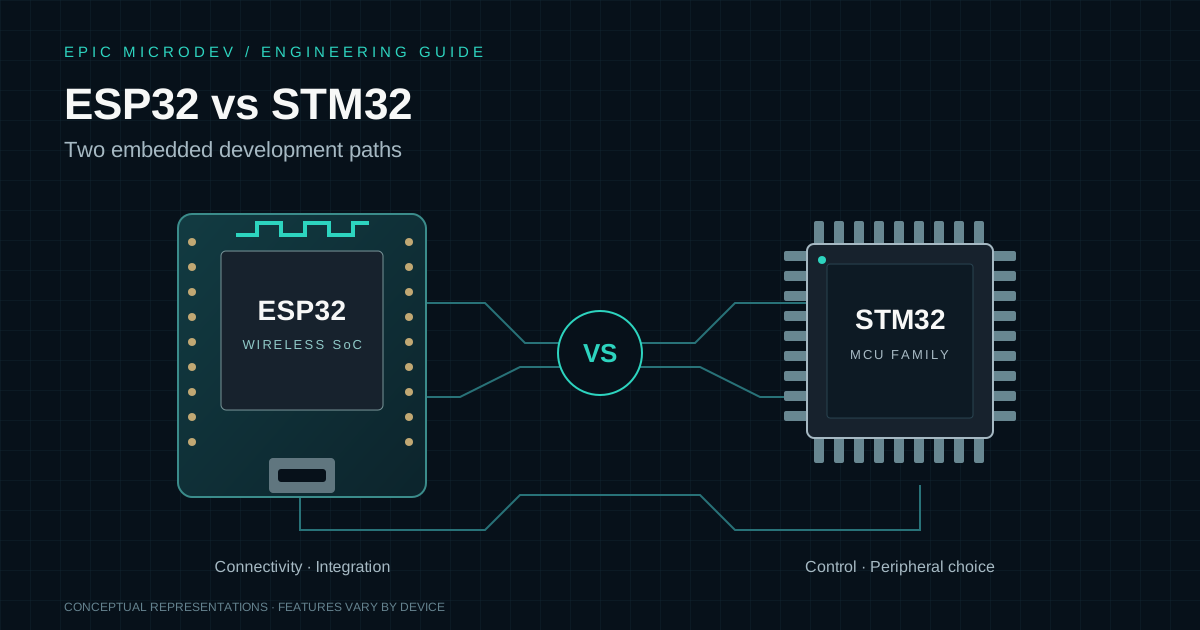
ESP32 and STM32 both support serious embedded products. The useful comparison is how each ecosystem fits your connectivity, timing, power and production requirements—not which brand wins overall.
Both names describe families of microcontrollers (MCUs). An ESP32-S3 differs substantially from an ESP32-C3 or ESP32-P4, just as an STM32C0 differs from an STM32H7, STM32U5 or STM32WBA. Treat this guide as a way to build a shortlist; make the final decision using the selected device’s documentation and a representative prototype.
ESP32 vs STM32 at a glance
Start with ESP32 when integrated Wi-Fi and connected-product development are central requirements. Evaluate STM32 when precise control, analog peripherals, low-power options or a broad choice of packages and memory configurations drive the design. Wireless STM32 families also deserve consideration for Bluetooth and Thread products.
On smaller screens, scroll horizontally to read all three columns.
| Requirement | ESP32 | STM32 |
|---|---|---|
| Wi-Fi | Integrated on many variants; check the selected device | Usually requires a separate device or module |
| Bluetooth LE, Thread and Zigbee | Available on selected families; protocol support varies | Wireless WB/WBA families; support varies by device |
| Processing and control | Xtensa or RISC-V cores; evaluate timing under application load | Broad Arm Cortex-M portfolio with control-oriented options |
| Low-power operation | Sleep modes and low-power features vary by device | Dedicated low-power families and wireless options |
| Analog and timers | Check the exact peripheral capabilities | Broad selection of timers and analog peripherals |
| Development tools | ESP-IDF with FreeRTOS and networking integration | STM32Cube tools, drivers and middleware |
| Product cost | Integration can reduce external components | Device selection can closely match non-wireless requirements |
These are selection tendencies, not benchmark results. Neither family is always faster, cheaper or more energy-efficient. A capability listed for an ecosystem may be absent from the particular chip you select.
1. Connectivity: choose the radio architecture first
Many ESP32 devices integrate wireless connectivity into the system-on-chip. The ESP32-S3, for example, combines 2.4 GHz Wi-Fi and Bluetooth Low Energy (LE). For a device that reads sensors, connects to a local network and sends data to a cloud service, that integration can simplify both the circuit board and firmware.
Using one processor can remove a separate radio interface and the firmware needed to coordinate two processors. However, confirm which protocols the exact ESP32 variant supports. The family name alone does not establish Wi-Fi, Bluetooth or Thread capability, and a development board’s features may include components outside the chip.
STM32 also includes wireless families. Selected STM32WB and STM32WBA devices support Bluetooth LE and IEEE 802.15.4-based technologies such as Thread and Zigbee. For a low-power wireless product, compare those devices against suitable ESP32 variants rather than comparing ESP32 with a non-wireless STM32.
Make the network requirement specific: direct Wi-Fi access, a Bluetooth connection to a phone, or a Thread network imply different architectures. Include provisioning, expected coverage and radio duty cycle in the decision. A Matter requirement also needs a compatible device and software stack; it is not a substitute for choosing the underlying connectivity.
2. Performance and control: look beyond clock speed
Clock frequency alone is a poor comparison. Processor architecture, memory access, software workload and hardware peripherals all affect useful performance. ESP32 includes Xtensa and RISC-V devices; STM32 spans multiple Arm Cortex-M cores across mainstream, low-power, wireless and high-performance families.
The ESP32-S3’s dual Xtensa LX7 cores and ESP-IDF’s FreeRTOS integration can suit applications that combine networking, sensors, a display and application logic. A real-time operating system helps organise concurrent work, but it does not establish that every task will meet its deadline. Wireless activity, interrupts and scheduling need attention when timing requirements are strict.
STM32’s peripheral selection is particularly relevant to control applications. Depending on the device, available features include advanced timers, pulse-width modulation (PWM), analog-to-digital converters (ADCs), comparators and direct memory access (DMA). Coordinating those peripherals can reduce processor work and help achieve precise sampling and output timing.
Consider a hypothetical motor controller: synchronised PWM, current sampling and fast fault response may favour an STM32 designed for control. A hypothetical Wi-Fi environmental monitor may benefit more from ESP32’s connectivity integration. ESP32 can also control motors, and STM32 can serve connected products; the required timing and interfaces determine the fit.
For shortlisted devices, check memory headroom, peripheral availability and worst-case timing with the intended workload running. List the interfaces you need simultaneously, then check the selected package and pin assignments. A device can have the right peripheral names yet still be unsuitable for your board layout or concurrency requirements.
3. Power: compare a complete operating cycle
Neither ecosystem has one meaningful power-consumption figure. Sleep current, radio use, wake-up frequency, processing time, regulators, sensors and board leakage all contribute. STM32 offers dedicated ultra-low-power families such as STM32U5. ESP32 devices also offer sleep modes and low-power features, with capabilities depending on the chip.
Compare the energy needed to perform the actual job. A sensor that reports once an hour has a different profile from a controller maintaining an active Wi-Fi connection. The lowest datasheet sleep current is useful only if the product spends enough time in that state and the rest of the board can sleep with it.
Average current = total charge consumed ÷ elapsed time. For distinct operating states: Iavg = Σ(Istate × tstate) ÷ Tcycle. Use current measurements at the same supply point and include all states in the cycle.
Measure sleep, wake-up, sensing, processing and transmission at the battery or a clearly defined supply rail. Include connection attempts and retries in representative conditions. When comparing energy across different supply voltages, account for voltage and regulator losses rather than adding currents measured on unrelated rails.
Prototype the firmware and power architecture before committing to a battery-life target. A development board can help evaluate software, but its regulator, indicators and debug circuitry may differ from the production design. Use measurements that reflect the final operating conditions rather than treating the board’s current as the MCU’s current.
4. Tools and security: plan the firmware lifecycle
Development workflow
Espressif’s native framework, ESP-IDF, brings together drivers, networking, FreeRTOS, configuration, logging and over-the-air (OTA) update APIs. This can shorten the route to a working connected prototype. Arduino support offers another entry point, but evaluate the framework and libraries you intend to maintain in the shipped product.
STM32Cube provides configuration, development, programming and debugging tools alongside device-family software packages. STM32CubeMX, STM32CubeIDE and ST-LINK are common parts of that workflow; ST also provides a VS Code development path. The breadth of device and peripheral choices provides flexibility, while adding selection and configuration work.
Choose with the team’s workflow in mind. Build a small vertical prototype that exercises a required peripheral, communication path and debugger. That reveals whether the drivers, examples and debugging tools support your work before a larger application depends on them.
If your ESP32 prototype will not upload, use our flashing guide to separate host-port, download-mode and electrical problems before changing toolchains.
Security and maintenance
Security capabilities vary within both families. Applicable ESP32 devices provide secure boot, flash encryption and hardware cryptographic features. Espressif documents using secure boot and flash encryption together for stronger protection. Selected STM32 families provide features such as TrustZone isolation, cryptography and secure boot mechanisms; verify each requirement against the exact part.
Before choosing the MCU, decide how firmware will be signed, where keys will live, how devices will be provisioned and how production debug access will be controlled. Define update verification and recovery as well. Hardware features support these decisions, but the complete provisioning and maintenance process still needs engineering.
5. Product cost: compare the whole system
Compare the system bill of materials (BOM), not just MCU unit prices. Integrated connectivity can reduce component count, printed circuit board (PCB) area and software coordination. Conversely, a product with no radio requirement may be better served by a small STM32 matched closely to its control and interface needs.
Separate chip, module and development-board comparisons. A module may include memory and radio-related components that a bare chip needs externally. Check what each candidate actually includes before comparing costs or estimating board complexity; do not assume every ESP32 package includes the same memory arrangement.
Include engineering effort, production programming, test fixtures, certification work and ongoing firmware support. Check component availability and future product variants before committing. A cheap prototype architecture can become expensive if it needs substantial redesign for manufacturing, power targets or field maintenance.
For an initial decision, make a small costed architecture for each candidate rather than chasing a universal price winner. Record which external components disappear, which new integration tasks appear and which assumptions remain untested. That makes the trade-off reviewable without pretending that today’s component price settles the product’s lifetime cost.
Which should you shortlist?
- Start with ESP32 for a Wi-Fi sensor, smart-home controller or connected interface where integrated networking and a compact system architecture are priorities. Confirm that processing, memory, timing and power requirements fit the selected variant.
- Evaluate STM32 strongly for motor control, instrumentation or an industrial control board where timers, analog measurement and predictable response dominate. Choose the relevant control or low-power family rather than treating the portfolio as interchangeable.
- Compare both wireless portfolios for Bluetooth LE or Thread products. The final contest is between specific devices, software stacks and power architectures—not an ESP32 family label and an unspecified STM32.
If both candidates meet the requirements, let the prototype expose the remaining risks. Prefer the architecture your team can validate, manufacture and maintain with sufficient headroom. A familiar toolchain matters, but it should not override an unmet timing, security or power requirement.
A compact selection checklist
- Connectivity: specify protocols, provisioning, coverage and whether another processor or modem is required.
- Timing and memory: define deadlines, acceptable jitter, processing load and memory headroom for the complete application.
- Power: model a full operating cycle and measure representative firmware on suitable hardware.
- Interfaces: check simultaneous peripheral use, pin assignments, package constraints and required analog performance.
- Security: agree signing, key storage, provisioning, debug access and verified update recovery.
- Production: review availability, assembly, programming, test, certification needs and the support lifetime.
Turn each item into an acceptance criterion before selecting the exact part. Keep a short record of why the alternatives were rejected; it makes later component substitutions and product variants easier to assess.
Frequently asked questions
Is ESP32 suitable for commercial products?
Yes, but select the device for the product’s performance, environment, security and lifecycle requirements. A working development-board demonstration is a useful milestone, not evidence that the production hardware, provisioning and maintenance processes are ready.
Which is easier for beginners?
ESP32 often offers a shorter path to a Wi-Fi prototype because ESP-IDF integrates networking and FreeRTOS. STM32’s wider device and peripheral selection can require more initial configuration. For either platform, good debugging habits and familiarity with the selected framework become important as the application grows.
Does STM32 have built-in wireless connectivity?
Some families do. STM32WB and STM32WBA include wireless devices, with Bluetooth LE and Thread or Zigbee support depending on the part and software stack. Check the specific device rather than assuming that every member supports every protocol.
Which uses less power?
There is no family-wide winner. Compare suitable parts using the complete operating cycle, including sensors, regulators, radio activity and retries. Dedicated low-power features help only when the application and board design can use them effectively.
Plan maintenance alongside MCU selection
Once devices are deployed, update failures become a product-support problem. Our embedded Linux OTA guide covers signed releases, recovery and staged rollouts. Its system-level questions are useful background, although MCU update implementations and boot arrangements differ from embedded Linux.
Official references
- Espressif: ESP32-S3 features and documentation
- ESP-IDF: development framework
- ESP-IDF: FreeRTOS and symmetric multiprocessing
- ESP-IDF: secure boot, flash encryption and security
- ST: STM32 microcontroller portfolio
- ST: STM32WB wireless microcontrollers
- ST: STM32WBA wireless microcontrollers
- ST: STM32U5 ultra-low-power family
- ST: STM32CubeIDE development tools
Related articles
Embedded & Firmware
ESP32 Won’t Flash? Fix “Failed to Connect” and esptool Errors
Find the failing stage—USB detection, download mode, serial communication or transfer—and use targeted checks for development boards and custom ESP32 hardware.
Read article →Firmware
Planning Reliable OTA Updates for Embedded Linux Devices
A readiness checklist and failure-test matrix for connected products: plan trusted releases, recoverable installation and controlled fleet rollouts before devices leave the workshop.
Read article →