ESP32-S3 vs ESP32-C5: Which Should You Choose in 2026?
In This Article
The ESP32-S3 and ESP32-C5 can both power connected embedded products, but they are optimized around different constraints.
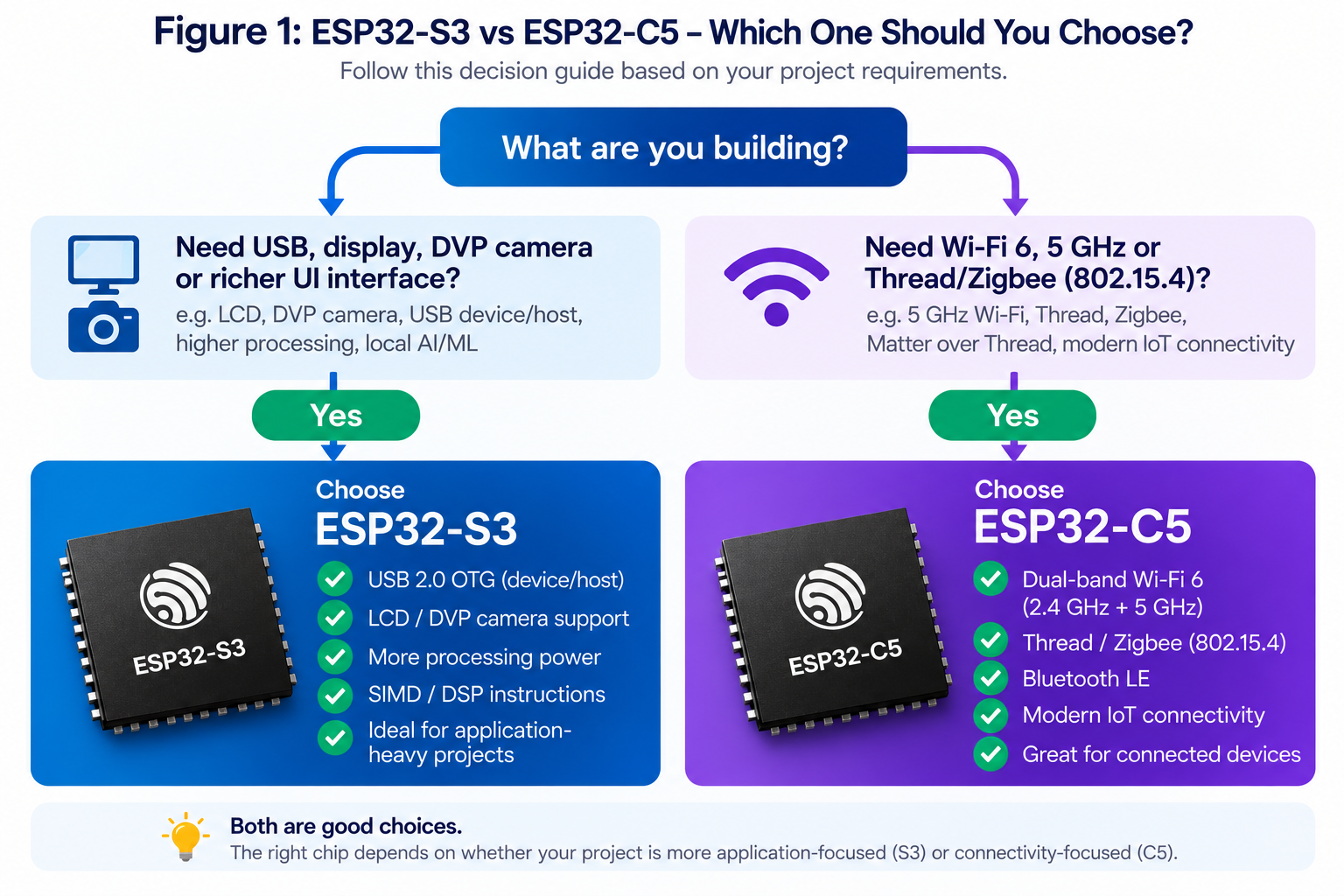
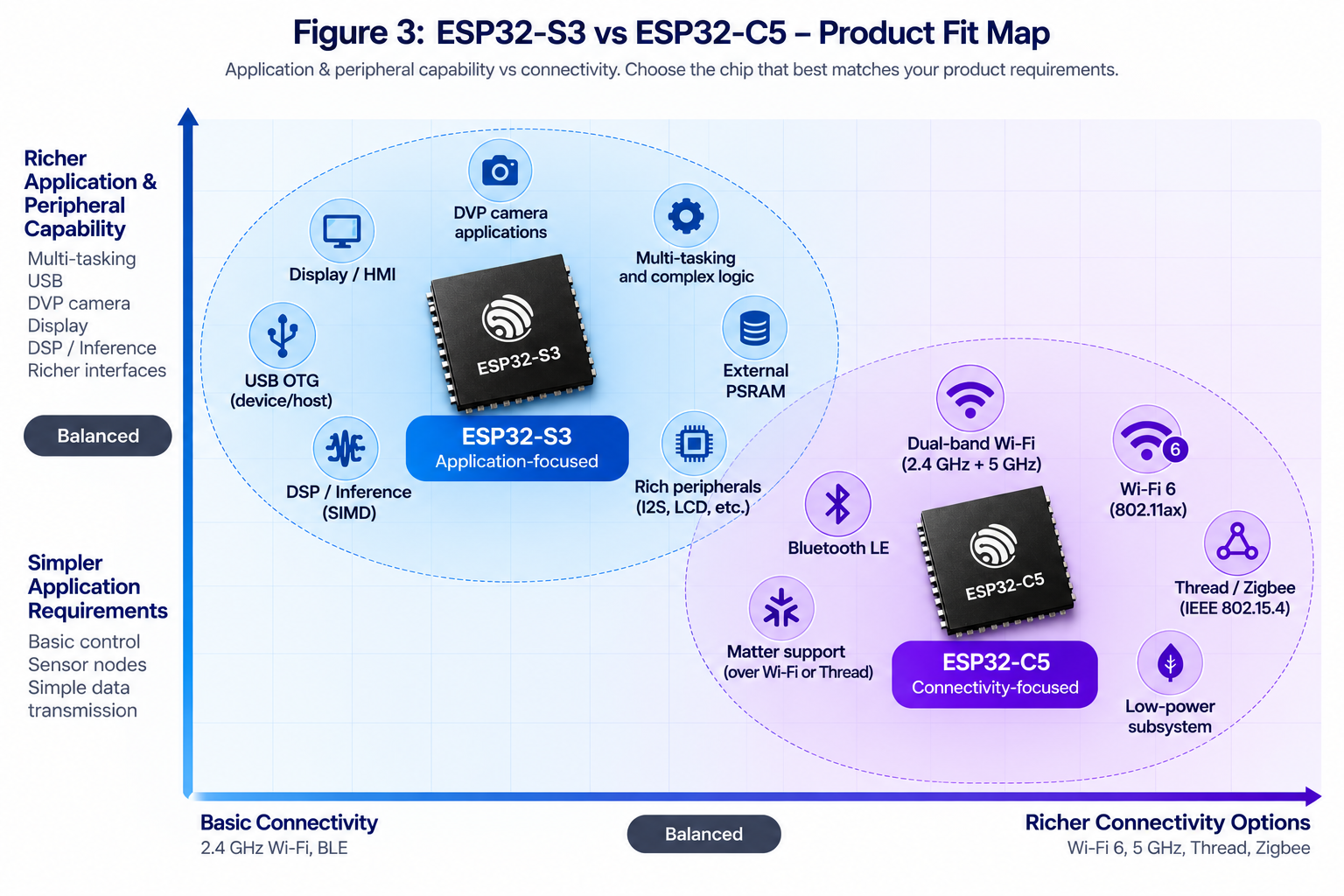
Choose the ESP32-S3 first when the product needs stronger application-side capability: dual application cores, programmable USB OTG, camera/display interfaces, external PSRAM options, or workloads that can benefit from its SIMD/vector instructions.
Choose the ESP32-C5 first when connectivity drives the architecture: 2.4 GHz + 5 GHz Wi-Fi 6, Bluetooth LE, and an integrated IEEE 802.15.4 radio for Thread and Zigbee.
The useful question is not which chip is newer?
It is:
Is the hardest requirement in your product application processing and peripherals, or modern wireless connectivity?
30-second verdict
On smaller screens, scroll horizontally to read all three columns.
| Your requirement | Evaluate first | Why |
|---|---|---|
| USB device/host functionality | ESP32-S3 | Full-speed USB 2.0 OTG |
| Camera or display-heavy application | ESP32-S3 | Application/peripheral fit |
| DSP / lightweight inference | ESP32-S3 | Dual cores + SIMD/vector instructions |
| 5 GHz Wi-Fi | ESP32-C5 | Integrated dual-band 2.4/5 GHz radio |
| Wi-Fi 6 | ESP32-C5 | 802.11ax support |
| Thread or Zigbee | ESP32-C5 | Integrated IEEE 802.15.4 |
| Matter over Thread | ESP32-C5 | 802.15.4 radio available |
| Basic Wi-Fi + BLE product | Compare both | Memory, USB, peripherals, cost and software decide |
| Existing mature S3 product | Usually keep S3 | Migration needs a concrete benefit |
These are evaluation starting points, not absolute rules.
ESP32-S3 vs ESP32-C5 specifications
On smaller screens, scroll horizontally to read all three columns.
| Feature | ESP32-S3 | ESP32-C5 |
|---|---|---|
| Application CPU | 2 × Xtensa LX7 | 1 × high-performance RISC-V |
| Maximum application CPU clock | Up to 240 MHz | Up to 240 MHz |
| Low-power processing | ULP coprocessors | Separate low-power RISC-V processor |
| Wi-Fi | 2.4 GHz Wi-Fi 4 | 2.4 + 5 GHz Wi-Fi 6 |
| Bluetooth | Bluetooth LE | Bluetooth LE |
| IEEE 802.15.4 | No | Yes |
| Thread / Zigbee | No integrated 802.15.4 radio | Supported with the appropriate software stack |
| Programmable USB | Full-speed USB 2.0 OTG | USB Serial/JTAG; not equivalent to S3 USB OTG |
| Vector / SIMD instructions | Yes | Different RISC-V compute architecture |
| External memory | Flash/PSRAM options depending on device/module | Flash/PSRAM options depending on variant/module |
| Typical product fit | USB, display, camera, DSP, richer application logic | Dual-band Wi-Fi, Wi-Fi 6, Thread/Zigbee, multiprotocol IoT |
A shared 240 MHz headline does not make these devices equivalent. The S3 gives you two application cores and a peripheral set aimed at richer local workloads. The C5 concentrates much more of its differentiation in the wireless subsystem.
The main architectural difference
ESP32-S3: application-centric
Think of the S3 as the stronger starting point when the difficult part of the product happens inside the device:
- USB host/device behavior
- camera capture
- display/UI work
- multiple substantial application tasks
- audio or signal processing
- buffering with external PSRAM
- suitable DSP or lightweight inference workloads
Its two Xtensa LX7 application cores can run up to 240 MHz, and Espressif documents SIMD/vector instructions intended to accelerate suitable DSP and neural-network kernels.
That does not mean every S3 application is automatically fast. Memory traffic, peripheral bandwidth, task synchronization and the actual algorithm still determine system performance.
ESP32-C5: connectivity-centric
The C5 becomes more compelling when the difficult requirement is how the product connects.
It combines:
- 2.4 GHz Wi-Fi
- 5 GHz Wi-Fi
- Wi-Fi 6 (802.11ax)
- Bluetooth LE
- IEEE 802.15.4
- Thread
- Zigbee
That combination lets one product family cover use cases that would otherwise require a different radio strategy.
Wi-Fi: when C5 changes the architecture
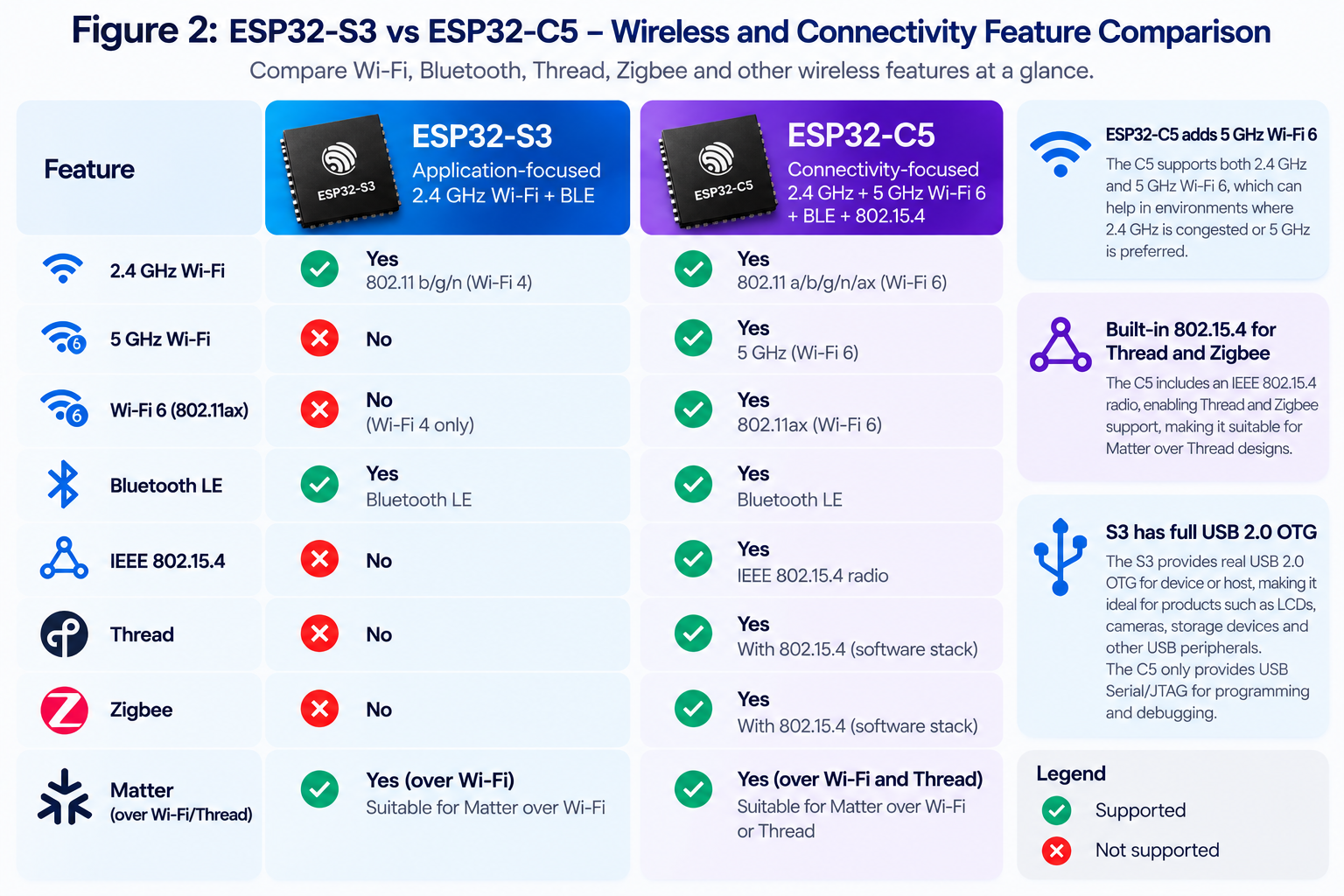
The S3 provides 2.4 GHz Wi-Fi 4, which remains enough for many embedded products:
- sensors
- appliances
- connected controllers
- telemetry devices
- instruments
- local web interfaces
The C5 adds Wi-Fi 6 and 5 GHz operation while retaining 2.4 GHz support.
That is useful when the deployment environment has crowded 2.4 GHz spectrum, depends on 5 GHz infrastructure, or benefits from newer Wi-Fi 6 capabilities.
But 5 GHz is not automatically “better.” Propagation through walls and obstacles differs from 2.4 GHz, and a small sensor sending occasional telemetry may gain little from the additional band.
Test the final antenna, enclosure, access points and installation environment.
Thread, Zigbee and Matter
This is a hard architectural dividing line.
The C5 includes IEEE 802.15.4 hardware. With the appropriate software stack, that makes it a candidate for:
- Thread
- Zigbee
- Matter over Thread
- multiprotocol products that combine Wi-Fi/BLE/802.15.4
The S3 does not contain an integrated 802.15.4 radio.
On smaller screens, scroll horizontally to read all three columns.
| Product requirement | S3 | C5 |
|---|---|---|
| Matter over Wi-Fi | ✓ | ✓ |
| Matter over Thread | — | ✓ |
| Thread endpoint | — | ✓ |
| Zigbee device | — | ✓ |
| Wi-Fi + BLE | ✓ | ✓ |
| Wi-Fi + Thread/Zigbee in one SoC | — | ✓ |
Matter support still requires the right software stack, commissioning flow, credentials and product implementation. A radio feature alone does not create a production-ready Matter device.
USB: where S3 has the clearer advantage
The S3 provides a full-speed USB 2.0 OTG controller with an integrated transceiver.
That matters when USB is part of the product rather than only a programming interface.
Examples include:
- USB HID products
- USB serial devices
- USB-connected instruments
- embedded USB device classes
- selected host-mode applications
The C5 provides USB Serial/JTAG, which is valuable for programming and debugging but should not be treated as equivalent to S3's programmable USB OTG controller.
One hardware consideration: the ESP32-S3's USB OTG and USB Serial/JTAG controllers share the internal USB PHY. Designs that need both simultaneously may require an external PHY or an alternative JTAG/debug path.
Rule of thumb: if the product itself needs meaningful USB functionality, evaluate the S3 first.
Display, camera and local processing
The S3 fits naturally into products where local processing and peripherals dominate the design.
Typical examples include smart displays/HMIs, camera nodes, audio/signal-processing devices and lightweight edge-inference workloads.
The C5 should not be rejected simply because the application has a UI or local processing. The question is whether those demands are important enough to outweigh its stronger connectivity options.
Memory and module selection
Choosing “S3” or “C5” is not the final hardware decision.
You still need to choose the exact SoC, module or board configuration, including:
- flash capacity
- PSRAM availability and capacity
- package/module
- antenna option
- accessible GPIO
- temperature grade
- certification needs
- supply and lifecycle
For a real product, estimate peak memory rather than looking only at idle free heap.
Include TLS/network buffers, OTA storage, task stacks, framebuffers, image/audio buffers, logging, protocol bursts and application assets.
External PSRAM increases capacity, but it is not identical to internal SRAM in latency, cache behavior or peripheral/DMA constraints.
What about power consumption?
There is no useful single current figure that tells you which family gives better battery life for every product.
Measure a complete application cycle:
Wake → sense → process → connect → transmit → acknowledge → sleep
The final energy budget depends on radio band, signal strength, retries, association/reconnection, CPU workload, sleep strategy, sensors, regulators, external memory and other board components.
A 5 GHz-capable device is not automatically less efficient, and a lower idle current does not automatically produce longer field battery life.
Five practical product decisions
On smaller screens, scroll horizontally to read all columns.
| Product | Evaluate first | Main reason | Validate before committing |
|---|---|---|---|
| USB-connected industrial instrument | S3 | USB OTG + richer application peripherals | USB class, task timing, display/peripheral load |
| Matter-over-Thread sensor | C5 | Integrated 802.15.4 | Stack support, commissioning, energy budget |
| Dual-band Wi-Fi controller | C5 | 2.4 + 5 GHz Wi-Fi 6 | RF coverage, AP compatibility, antenna design |
| Camera with local processing | S3 | Camera/application ecosystem + compute structure | Buffering, PSRAM, frame rate, processing pipeline |
| Simple Wi-Fi + BLE sensor | Compare both | Neither feature set automatically wins | Cost, memory, pins, availability, software reuse |
USB-connected instrument
If your product needs a real USB device interface, local UI and substantial application logic, the S3 is usually the first prototype to build.
Matter-over-Thread endpoint
If Thread is part of the required network architecture, C5 immediately becomes the stronger candidate because the required 802.15.4 radio is integrated.
Dual-band connected controller
If the deployment network requires or strongly benefits from 5 GHz, the C5 has the architectural advantage. Still test actual coverage and reconnect behavior inside the final enclosure.
Camera or local inference node
Start with S3 when camera capture, buffering, DSP or lightweight inference are central requirements. Prototype the real processing pipeline early.
Simple telemetry device
If the product only needs Wi-Fi, BLE, GPIO and modest application logic, neither chip automatically wins. Module price, existing firmware, memory, pin count, certification, availability and support lifetime may decide the design.
Final decision matrix
On smaller screens, scroll horizontally to read all columns.
| If this is the hard requirement... | Evaluate first |
|---|---|
| Dual-core application workload | ESP32-S3 |
| USB host/device capability | ESP32-S3 |
| Camera/display-oriented application | ESP32-S3 |
| SIMD/DSP-friendly processing | ESP32-S3 |
| 5 GHz Wi-Fi | ESP32-C5 |
| Wi-Fi 6 | ESP32-C5 |
| Thread | ESP32-C5 |
| Zigbee | ESP32-C5 |
| Matter over Thread | ESP32-C5 |
| Basic Wi-Fi + BLE | Compare both |
| Existing proven S3 design | Usually keep S3 unless C5 solves a real constraint |
ESP32-S3 or ESP32-C5?
Choose ESP32-S3 when the difficult part of the product is the application: USB, displays, cameras, concurrent processing, buffering or suitable DSP/inference workloads.
Choose ESP32-C5 when the difficult part is connectivity: 5 GHz Wi-Fi, Wi-Fi 6, Thread, Zigbee or a broader multiprotocol radio requirement.
If your requirement is simply “Wi-Fi + BLE + some GPIO,” do not select from the marketing feature list alone. Compare the exact modules, memory configuration, peripheral routing, software support, availability and total product cost.
The best question is:
Which chip removes the hardest constraint from this product?
If you have not narrowed the ESP32 family down to S3 and C5 yet, see our ESP32 Family Comparison 2026.
If you are still deciding between Espressif and STM32, start with ESP32 vs STM32 in 2026.
Need help choosing an MCU or validating firmware architecture for a custom embedded product? Discuss your firmware project.
Official references
Technical claims were rechecked on 28 October 2026 against current official Espressif documentation. During implementation, use the latest available documentation revision if Espressif has published a newer one.
Related articles
Embedded & Firmware
ESP32 Family Comparison 2026: Which ESP32 Should You Choose?
Choose by radio, workload and product constraints: a practical guide to ESP32-S3, C3, C5, C6, C61, H2, P4 and S31, with H4 and original ESP32 context.
Read article →Embedded & Firmware
ESP32 vs STM32 in 2026: Which Microcontroller Should You Choose?
ESP32 or STM32? Compare connectivity, performance, power, peripherals, security and development workflows to choose the right MCU for your product.
Read article →